

₹799.00 Original price was: ₹799.00.₹650.00Current price is: ₹650.00.
The rapid advancement of artificial intelligence over the past decade has been inseparable from an equally rapid accumulation of data. Centralized learning paradigms—built on the assumption that data can be freely collected, pooled, and processed—have powered remarkable breakthroughs in vision, language, and decision systems. Yet this same assumption now stands in tension with the realities of modern computing environments. Rising data volumes, stringent privacy regulations, institutional data silos, and escalating infrastructure costs have collectively exposed the structural limits of centralized intelligence.
This book is written at the inflection point where these tensions can no longer be treated as secondary concerns. Privacy is no longer an ethical afterthought, regulation is no longer an external constraint, and system scalability is no longer guaranteed by brute-force aggregation. Instead, intelligence itself must be re-architected.
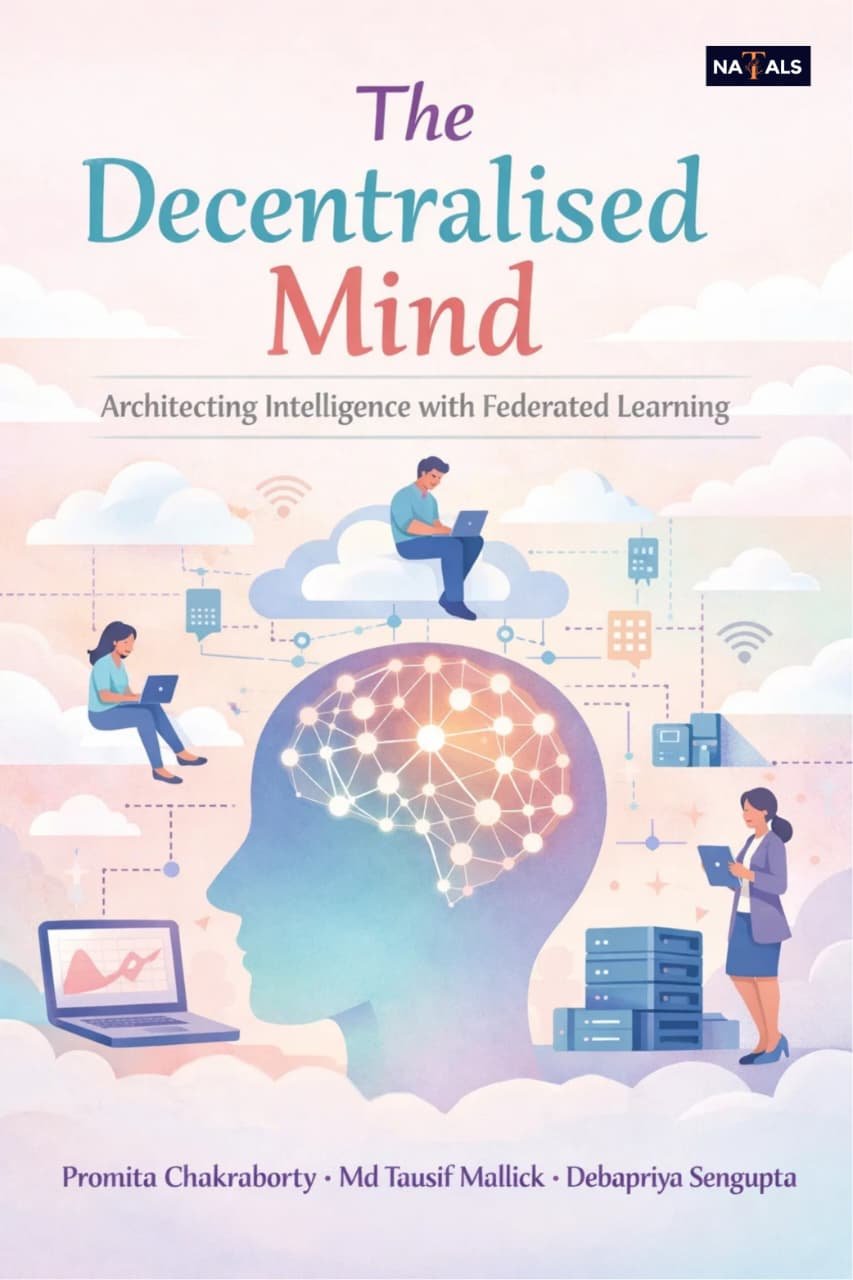
The Decentralised Mind: Architecting Intelligence with Federated Learning examines this transformation through the lens of federated learning—a paradigm that redefines how models learn when data cannot move. Rather than positioning federated learning as a niche technique or a privacypreserving add-on, this book treats it as a foundational shift in the design of intelligent systems. Federated learning emerges here not merely as an algorithmic innovation, but as a response to deep economic, legal, and infrastructural constraints that now shape the future of AI.
The central argument of this book is that decentralized intelligence is not optional—it is inevitable. As data becomes increasingly immobile by design, computation must move to the data. This inversion reshapes every layer of the machine learning stack: optimization, system architecture, security, evaluation, governance, and regulation. Understanding federated learning therefore requires more than familiarity with update rules or aggregation strategies; it demands a systems-level perspective that integrates theory, engineering realities, and legal context.
Accordingly, this book is structured to move from first principles to practical deployment. Early chapters establish the privacy-first paradigm shift, tracing the economic and regulatory pressures that render centralized learning unsustainable. Subsequent chapters formalize the architectural foundations of federated learning, including the client–server ecosystem, the FedAvg algorithm, and the role of partial participation and secure aggregation. As the discussion progresses, the focus expands to encompass horizontal and vertical federated learning, personalization strategies, convergence behavior under non-IID data, system-statistical trade-offs, and the governance challenges that persist even in decentralized settings.
Throughout the book, emphasis is placed on clarity, rigor, and realism. Mathematical formulations are introduced where they illuminate core ideas, but never in isolation from system constraints. Real-world deployments—from mobile devices to healthcare consortia—are used not as illustrative anecdotes, but as evidence of how federated learning operates under genuine operational pressure. Legal and regulatory analysis is woven directly into the technical narrative, reflecting the reality that compliance now shapes architecture as much as performance does.
This book is intended for a diverse but technically engaged audience: graduate students and researchers seeking conceptual depth, practitioners designing privacy-aware learning systems, and policymakers or technologists interested in the structural implications of decentralized AI. While no prior expertise in federated learning is assumed, readers are expected to engage critically with the ideas presented and to view machine learning not merely as an optimization problem, but as a socio-technical system embedded in real constraints.
Ultimately, The Decentralised Mind is an exploration of how intelligence must evolve when data cannot be centralized, visibility cannot be assumed, and coordination must replace control. Federated learning is not portrayed here as a final solution, but as the first coherent blueprint for learning under constraint. As artificial intelligence continues to expand into sensitive, regulated, and distributed domains, the principles articulated in this book will become increasingly central to how intelligent systems are conceived, built, and governed.




Reviews
There are no reviews yet.